A five-second Gen-4.5 clip costs 60 credits on Runway, or about $0.60 once those credits are priced at the $0.01 top-up rate, and that per-output number decides a Runway budget rather than the sticker price. Individual plans run from $0 on Free to $95 per month on Max. Teams of 2–9 use the separate Team plan, where each paid seat adds credits to a shared monthly pool.
Two things changed in 2026 that most pricing pages still get wrong. Unlimited is gone for new buyers and has been replaced by Max, and Gen-4.5 now costs 12 credits per second rather than the higher rate several ranking articles still quote.
The practical starting point for one creator is Standard at $12 per month on annual billing. For 2–9 collaborating editors, use Team: each seat adds 6,900 monthly credits to the shared pool. Prices and plan rules below were rechecked against Runway pricing and Team pricing on October 6, 2026.
Credit units are not comparable between platforms, so cross-shop with the wider market of AI video generators and read the workflow detail in the Runway review before committing to a tier.
In This Article (22 sections)
Quick Verdict: Runway Pricing at a Glance
Runway’s individual tiers move on two axes at once: fee and credit allowance. The separate Team plan adds both a seat fee and 6,900 monthly credits per seat.
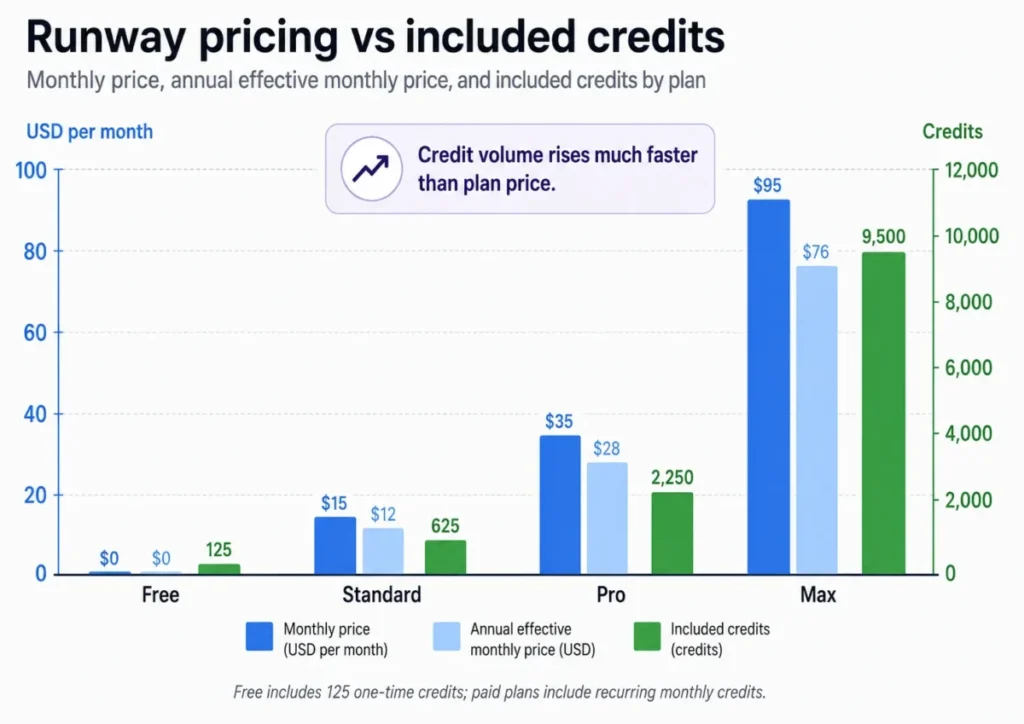
Individual-plan comparison: Max increases monthly credits to 9,500 while annual effective pricing rises to $76 per month. Team pricing follows a different per-seat model.
For one creator, the chart shows why expected credit use matters more than the subscription headline. For multiple collaborators, compare Team’s pooled 6,900 credits per seat instead of multiplying individual-plan fees.
If Runway is too expensive at these levels, the closest cheaper starting point is Firefly Standard for credit-metered image and video work.
| Decision point | What the official pages show on October 6, 2026 |
|---|---|
| Starting price | Free at zero cost with 125 one-time credits; cheapest paid entry is Standard at $12 per month for one creator on annual billing |
| Free plan or trial | Free plan, no time limit, videos carry a Runway watermark |
| Best plan for most paying creators | Standard for one creator with light output; Pro for a solo creator needing more credits or Custom Voices; Max for ProRes/ |
| Plan to avoid | Max for anyone who mainly wants relaxed unlimited retries, because that behavior left with Unlimited |
| Biggest hidden cost | Confusing individual plans with Team: Team adds 6,900 pooled credits for each paid seat |
Plan and Team terms rechecked October 6, 2026 against Runway pricing, Team pricing and the Help Center. Runway’s pricing card and Pro Help Center disagree about Pro storage; see the note below.
Runway ML Pricing and Plans
Runway sells individual Free, Standard, Pro and Max plans; a separate Team plan serves 2–9 collaborating editors, and Enterprise covers larger organizations. Individual paid plans have one generating seat. Team is priced per seat, and each Team seat adds credits to the workspace pool. The published annual effective prices are about 20 percent below monthly billing.
Annual buyers should note what the discount does not include. The subscription is prepaid for a year, yet plan credits still refresh monthly on the billing date rather than arriving as a single annual bank.
See the current individual plans and Team plan directly. Team uses different seat and credit rules from individual plans.
Runway also publishes annual credit totals that make the gap concrete. Standard delivers 7,500 credits per year, Pro delivers 27,000, and Max delivers 114,000.
| Plan | Monthly | Annual effective | Billing basis | Included credits |
|---|---|---|---|---|
| Free | $0 | $0 | One account | 125 one-time |
| Standard | $15 | $12 per month, $144 per year | One creator | 625 per month |
| Pro | $35 | $28 per month, $336 per year | One creator | 2,250 per month |
| Max | $95 | $76 per month, $912 per year | One creator | 9,500 per month |
| Team | $69 per seat | $55 per seat per month, billed yearly | 2–9 seats | 6,900 per seat per month, pooled |
| Enterprise | Custom | Custom | Annual contract | Custom pool |
Sources: individual pricing, Team pricing and credit rules, checked October 6, 2026. Annual figures are effective monthly prices paid on an annual bill.
Executive Summary: Runway Cost at 1, 5, 9 and 10 Editors
Runway’s Standard, Pro and Max plans are for one creator. Teams of two to nine use the separate Team plan. Each Team seat adds 6,900 monthly credits to one shared balance; at 10 people, Runway directs buyers to Enterprise. That makes seat count a key part of the plan decision.
| Scenario | Plan | Annual bill | Monthly credits | How credits work |
|---|---|---|---|---|
| 1 creator | Standard | $144 | 625 | Individual allowance |
| 2 creators | Team | $1,320 | 13,800 | One shared balance |
| 5 creators | Team | $3,300 | 34,500 | One shared balance |
| 9 creators | Team | $5,940 | 62,100 | One shared balance |
| 10 or more | Enterprise | Custom quote | Custom | Ask sales |
Team annual bills above are calculated as $55 per seat per month × 12 months; a five-person Team paying month to month costs $345 per month. Credits refresh monthly, with one month of rollover on Team. Compare the official Team plan with individual pricing, checked October 6, 2026.
What Each Runway Plan Includes
Runway Free
Free is an evaluation tier on the official pricing page with 125 one-time credits, 5 GB of asset storage, and a limited model selection that Runway changes over time. Those credits never expire, and they never refresh either.
Two gates matter more than the credit count. Generated videos carry a Runway watermark, and Free accounts cannot purchase additional credits at all.
Verdict: useful for judging model quality before paying, unusable as a pay-as-you-go production tier. Avoid if any output will reach a client, a monetized channel, or a paid ad.
Runway Standard
Standard costs $15 per month for one creator, or $144 per year ($12 per month effective) on the Runway pricing page. It includes 625 monthly credits, the full paid model lineup, 4K upscaling and watermark-free output.
Standard includes 4K composition exports and 2K image exports, but ProRes video and PNG sequence exports require Max or Enterprise, according to Runway’s export guide.
Verdict: a sensible default for one creator making a few clips per month. Choose Max if ProRes or PNG sequence delivery is mandatory, and compare Standard top-ups with Pro if credits are the only constraint.
Runway Pro
Pro costs $35 per month for one creator, or $336 per year ($28 per month effective), and includes 2,250 monthly credits. It adds Custom Voices for Lip Sync and text-to-speech. See Runway pricing.
ProRes and PNG sequence exports do not start at Pro: Runway says Max, legacy Unlimited and Enterprise can use them. Runway’s current pricing page lists 100 GB of storage for Pro while its Pro Help page says 500 GB; confirm the allowance in checkout if storage affects the purchase.
Verdict: Pro fits one creator with weekly output or a need for Custom Voices. If the goal is ProRes or PNG sequences, move to Max. If only a small number of credits are missing, compare a top-up with upgrading.
Runway Max
Max costs $95 per month for one creator or $912 per year ($76 per month effective), with 9,500 monthly credits. It includes ProRes and PNG sequence exports and up to one month of unused plan-credit rollover. See pricing and export availability.
One temporary offer ran when this guide first published. The official pricing page advertised unlimited Seedance 2.5 access for new Max subscriptions until August 14, 2026, and that window has since closed.
The offer no longer appears on the pricing page, so it is not a current Max benefit. Standard Max renews at $95 monthly or $912 annually for one creator with 9,500 monthly credits.
Re-verified against Runway’s official pricing page on October 6, 2026.
Verdict: Max suits one creator who consistently needs its 9,500 monthly credits or requires ProRes, PNG sequences or one month of rollover. Compare its $76 monthly equivalent on annual billing with Pro plus purchased credits at your expected usage.
Runway Enterprise
Enterprise is quoted, annual, and built around governance rather than a bigger number of credits. Runway lists single sign-on, workspace analytics, configurable teamspaces, organization-wide onboarding, priority support, custom credits, and custom team sizes.
The credit lifecycle also differs from the consumer tiers. Enterprise contract credits are a shared annual pool sized to the organization, they do not roll over at the end of the annual term, and admins can set credit spend notifications per user or workspace.
Verdict: the route for 10 or more people, multiple workspaces or security review requirements. Contact Runway for a quote based on team size and expected annual usage.
Source: official Enterprise credit documentation, checked August 12, 2026.
Feature Gates by Plan
Two gates deserve emphasis. Runway’s pricing page lists 100 GB for Pro and 500 GB for Max, while its Pro Help page lists 500 GB for Pro. Check your checkout screen for storage. ProRes and PNG sequences start at Max; SSO is an Enterprise feature.
| Gate | Free | Standard | Pro | Max | Team |
|---|---|---|---|---|---|
| Watermark-free video | No | Yes | Yes | Yes | Yes |
| Full paid model library | No | Yes | Yes | Yes | Yes |
| Buy extra credits | No | Yes | Yes | Yes | Yes |
| ProRes and PNG sequence export | No | No | No | Yes | Yes |
| Custom Voices | No | No | Yes | Yes | Yes |
| Credit rollover | No | No | No | One month | One month |
| Seats | 1 | 1 | 1 | 1 | 2–9 |
Sources: Runway pricing, export guide and Team plan, checked October 6, 2026.
What Runway Credits Buy in Practice
Credits are the real unit of cost, and the rate varies by model, duration, and resolution. Gen-4.5 consumes 12 credits per second in the official credit documentation, so a 5-second generation costs 60 credits before any retry.
Those columns are ceilings, not forecasts. Every failed or discarded attempt spends the same credits as a keeper, so a realistic plan applies a retry factor the buyer chooses rather than a published average.
Resolution and model family move the rate more than duration does. A four-second Seedance 2.0 Pro clip at 1080p costs 160 credits while a five-second Gen-4.5 clip costs 60, so switching model for a look can triple the cost of the same shot.
Runway also prices the same partner model differently by version, and the newer version is not always the pricier one. Nano Banana Pro 2 costs 11 credits per 2K image while the earlier Nano Banana Pro costs 20 credits at the same resolution.
Audio and music sit at the cheap end of the ladder, which changes the mix. Seed Audio 1.0 runs 15 credits per minute, Lyria 3 Clip costs 4 credits per song, and text to speech costs 1 credit per 50 characters, so 625 credits cover 31,250 characters of speech.
For image-led workflows the arithmetic gets friendlier still, which is why cross-shopping against dedicated AI image generators is worthwhile before buying video capacity. Gen-4 Image Turbo at 2 credits per image in the official model rates means a Standard plan covers 312 images per month.
| Model | Rate | Standard, 625 credits | Pro, 2,250 credits | Max, 9,500 credits |
|---|---|---|---|---|
| Gen-4.5 | 60 credits per 5s | 10 clips | 37 clips | 158 clips |
| Aleph 2.0 | 140 credits per 5s | 4 clips | 16 clips | 67 clips |
| Seedance 2.0 Pro 1080p | 160 credits per 4s | 3 clips | 14 clips | 59 clips |
| Gen-4 Image 1080p | 8 credits per image | 78 images | 281 images | 1,187 images |
| Gen-4 Image Turbo | 2 credits per image | 312 images | 1,125 images | 4,750 images |
Source: official pricing page model rates, checked August 12, 2026.
Runway cost calculator: credits, model, and team size
Set the model, the monthly volume, and the number of editors. The calculator returns the credits burned, the cheapest plan for that load, and the cost of a single finished output.
—
—
| Plan | Included credits | Seat fees | Top-up needed | Total per month | Cost per output |
|---|
- Runway publishes a 1,000-credit minimum at $0.01 per credit. This estimate assumes the exact amount above that minimum can be purchased; confirm checkout amounts.
- Standard, Pro and Max cover one creator. Team is for 2–9; 10+ requires Enterprise pricing.
- Free is excluded because its 125 credits arrive once, not monthly. Enter all attempts, including retries. Format-specific generation charges are not included.
Sources: Runway pricing and Team plan, checked October 6, 2026.
Where Runway’s Own Numbers Disagree
Runway publishes plan capacity in more than one place, and the pages do not always match. Anyone budgeting from a single page should know which conflicts exist.
The Gen-4 Turbo gap is the one that changes a spreadsheet. The pricing page implies about 6 credits per second, the plan guide implies about 5.2, and the developer documentation states 5 credits per second for the same model.
Treat the plan-specific and API pages as the more precise sources, and treat the rounded minutes on the plan guide as marketing arithmetic. Where a conflict affects a purchase, the safest move is to model the more expensive rate.
| Item | Pricing page | Help Center |
|---|---|---|
| Gen-4.5 on Standard | 52 seconds | 1 minute |
| Gen-4.5 on Max | 791 seconds | 12.5 minutes |
| Gen-4 Turbo on Standard | 104 seconds | 2 minutes |
| Max credit rollover | One month | Two pages still say credits never roll over |
| Max availability date | Not stated | May 29 on one page, June 1 on another |
Source: official credit documentation, checked August 12, 2026.
Line-Item Cost Breakdown: Every Billable Item
A useful way to read that table is cost per finished clip rather than cost per month. Dividing the annual Max fee by its 9,500 credits gives about eight tenths of a cent per credit.
On that basis a 60-credit Gen-4.5 clip carries roughly half a dollar of credits. At the published top-up rate on the official pricing page the same clip carries about six tenths of a dollar.
A workflow requiring three paid attempts per finished clip triples the credit cost of that output. Use your own retry rate when quoting client work.
Runway states that it charges no service fees of its own, so the list above is the whole invoice. Payment provider or bank fees sit outside Runway’s control and outside its refunds.
One unbilled cost belongs in the same budget. Runway says its video editor is no longer actively maintained and recommends a local editor for larger projects, which means an editing subscription elsewhere for anything past quick edits.
| Line item | Price | Notes |
|---|---|---|
| Standard, one creator | $144 per year | Or $15 monthly; 625 monthly credits |
| Pro, one creator | $336 per year | Or $35 monthly; 2,250 monthly credits |
| Max, one creator | $912 per year | Or $95 monthly; 9,500 monthly credits |
| Team seat | $660 per year | Or $69 monthly; adds 6,900 monthly credits to shared pool |
| Web top-up credits | From $10 per 1,000 | Separate purchased balance |
| Runway API credits | $0.01 each | Separate API balance |
Source: official credit purchase documentation, checked August 12, 2026.
Annual vs Monthly: The Real Savings Math
Runway’s published individual and Team annual rates are approximately 20% below their monthly rates. The figures below show the yearly cost for one creator.
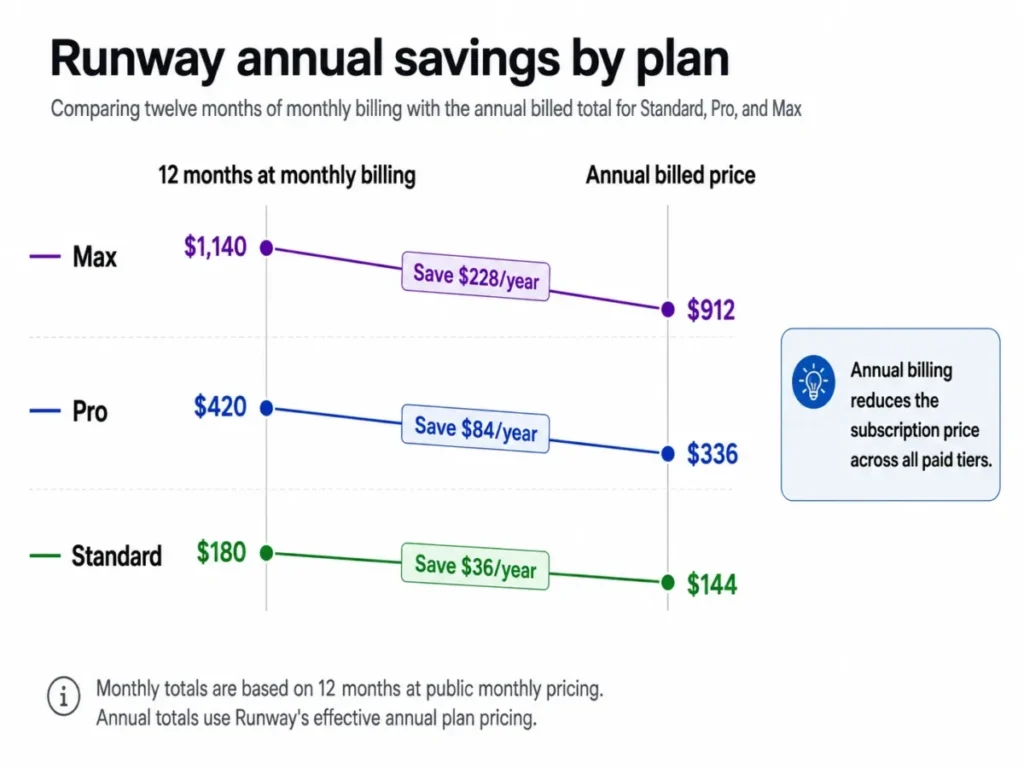
Runway annual billing saves $36 per year on Standard, $84 on Pro, and $228 on Max compared with paying monthly for 12 months.
The saving is proportional rather than tiered, so the chart above shows three parallel lines. The dollar gap widens with the plan price while the percentage stays fixed.
Annual billing saves 20% on Standard, Pro and Max for one creator: $36, $84 and $228 per year, respectively. For Team, $55 per seat monthly billed yearly is about 20% below $69 monthly.
Three contract details belong beside the discount. Subscriptions renew automatically until cancelled, credits refresh monthly rather than annually, and a refund granted on a prepaid year immediately removes plan access along with any unused plan credits.
A creator with a one-month project can pay $95 for one month of Max and its 9,500 monthly credits instead of committing to a year.
| Plan | Monthly rate | Annual rate for one creator | Discount |
|---|---|---|---|
| Standard | $15 per month | $144 per year | 20 percent |
| Pro | $35 per month | $336 per year | 20 percent |
| Max | $95 per month | $912 per year | 20 percent |
Source: official pricing page, checked August 12, 2026.
Buy Credits or Upgrade? Compare Your Actual Credit Demand
Runway lists purchased credits from $10 at $0.01 each, with a 1,000-credit minimum purchase. Its public documentation does not establish that every later purchase must be a 1,000-credit block. The calculator above uses the documented minimum and per-credit rate; check the available purchase amounts in your own checkout.
For one creator on annual billing, Standard costs $12 per month equivalent for 625 credits, Pro costs $28 for 2,250, and Max costs $76 for 9,500. A 1,000-credit top-up brings Standard to $22 and 1,625 available credits. Pro is only $6 more and includes 625 more credits, but the right choice depends on your exact monthly demand and feature needs.
| Monthly demand | Standard total | Pro total | Max |
|---|---|---|---|
| 1,000 credits | $22 / 1,625 available | $28 / 2,250 available | $76 / 9,500 available |
| 2,000 credits | At least $25.75 | $28 / 2,250 available | $76 / 9,500 available |
| 7,000 credits | At least $75.75 | At least $75.50 | $76 / 9,500 available |
| 9,000 credits | At least $95.75 | At least $95.50 | $76 / 9,500 available |
“At least” assumes you can buy the exact needed credits above Runway’s 1,000-credit minimum. Checkout pack sizes could raise the real price. Purchased credits do not expire while unused; plan credits are spent first. Feature gates also matter: Pro adds Custom Voices, while ProRes and PNG sequences require Max. Sources: pricing and minimum purchase and credit lifecycle, checked October 6, 2026.
Add-Ons, Overages, and Surprise Costs
For a Team workspace, budget the per-seat fee alongside shared credit demand and any purchased credits. Every new Team seat adds 6,900 monthly credits, so the extra fee also buys more generation capacity.
Retries are the main variable in production cost: a discarded generation spends credits too. Web and API credits use separate balances; a separate video editor may add another subscription. Runway lists organization-wide onboarding for Enterprise rather than a published self-serve setup fee.
| Cost | Published amount | When it appears |
|---|---|---|
| Additional Team seat | $69 monthly or $55 monthly billed yearly | Adds 6,900 monthly shared credits |
| Web credit purchase | From $10 at $0.01 per credit | When plan credits are insufficient |
| API credits | Separate API pricing | Automated pipelines |
| Local editor | Depends on tool | Workflows needing separate editing |
Refunds depend on Runway’s current policy and purchase history. Review its refund guidance and any Apple or Google store terms before purchasing. Team and credit prices: Runway Team and credit purchase guide, checked October 6, 2026.
Runway Team Pricing: Seats and Credits Scale Together
Runway Team covers two to nine people in one workspace. It costs $69 per seat per month or $55 per seat per month when billed yearly. Every seat adds 6,900 credits each month to one shared balance immediately; unused credits can roll over for one month.
A two-person Team therefore costs $138 per month or $1,320 per year on annual billing and has 13,800 monthly credits. A five-person Team costs $345 per month or $3,300 per year on annual billing and has 34,500 monthly credits. Usage is pooled, so members can draw from the same balance without individual credit limits.
Team includes Max features, shared projects, comments, 1 TB of workspace storage and credit top-ups. Organizations with 10 or more people, multiple workspaces or SSO needs should request Enterprise pricing. Source: Runway Team plan and FAQ, checked October 6, 2026.
Unlimited to Max: What Changed in 2026
Runway stopped selling Unlimited to new subscribers on June 1, 2026. The legacy plan includes 2,250 credits plus Explore Mode at relaxed speed; Max has 9,500 monthly credits and one month of rollover but no Explore Mode.
Runway updated the transition schedule on August 27, 2026. Eligible legacy Unlimited plans remain in place through November 30, 2026. Monthly subscribers switch automatically to Max on November 30 at $95 per month unless they cancel. Annual subscribers can choose in November between a refund for the remaining annual term and a credit bonus with migration.
For creators who rely on unlimited relaxed generations, the replacement is a material change: Max’s 9,500 credits are finite, covering about 13 minutes of Gen-4.5 across all attempts at 12 credits per second. Check the official transition notice for the terms sent to your account.
Runway API Pricing vs Web Plan Credits
Web credits and API credits share a name and nothing else. Runway states that credits bought in the web app never appear in an API balance and that the two are non-transferable in both directions.
Runway API credits cost $0.01 each in the developer portal, and the per-model rates are published separately. Gen-4.5 stays at 12 credits per second, Gen-4 Turbo runs 5 credits per second, Aleph 2.0 runs 28 credits per second with a 56-credit minimum, and Seedance 2.5 at 720p runs 30 credits per second with an 80-credit minimum.
The minimum charges are the part that surprises automated pipelines. Short clips can cost more than their duration implies, and reference video on Seedance is billed on top of output seconds.
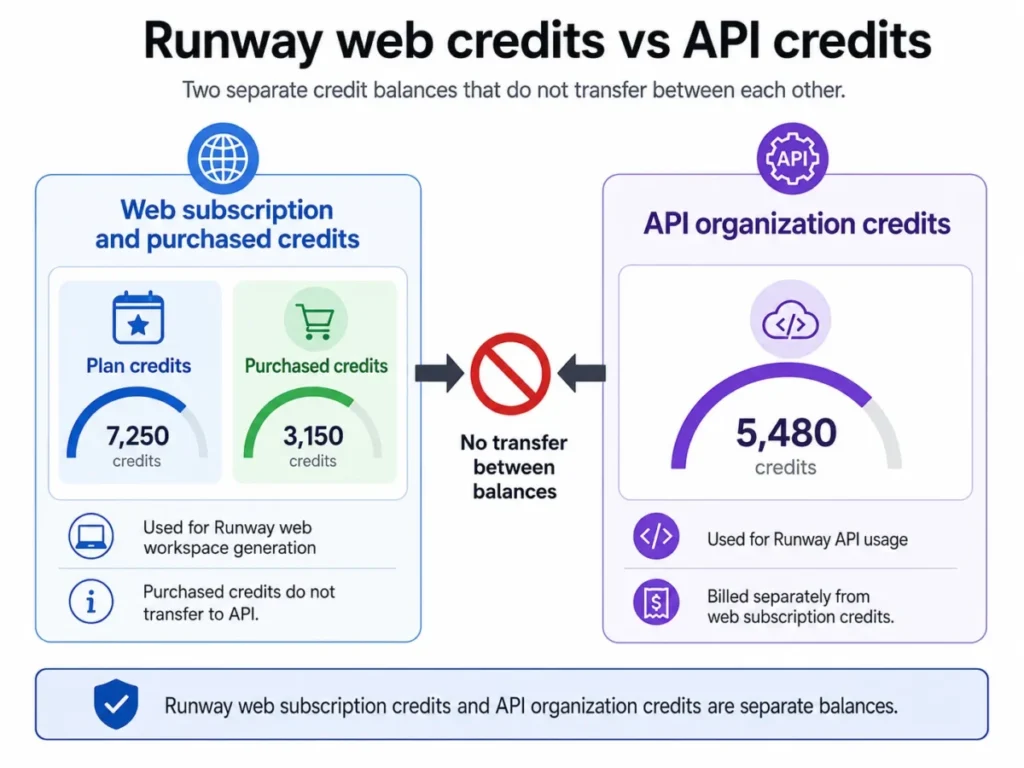
Runway web credits and API credits use separate balances and cannot be transferred between the web workspace and API organization.
Source: official API pricing documentation, checked August 12, 2026.
Which Runway Plan Should You Choose?
A solo creator testing model quality should stay on Free until the watermark or the model gate blocks the work. Free is the only tier where the credits never expire and never renew, which makes it a slow but permanent sandbox.
A freelancer delivering a few client clips per month can start with Standard. Its $144 annual price includes 625 monthly credits, watermark-free output and 4K upscaling; a purchased credit pack can cover occasional overflow.
A weekly creator should compare Standard top-ups with Pro’s 2,250 included credits and Custom Voices. Pro costs $336 per year for one creator. If a client requires ProRes or PNG sequence delivery, Max is the entry point.
For one creator producing daily, compare Max with Pro plus purchased credits at actual monthly demand. Max includes 9,500 monthly credits, ProRes and one-month rollover; exact top-up purchase options can affect the price comparison.
A group of two or three creators should evaluate Team: it starts at two seats, costs $55 per seat monthly when billed yearly, and adds 6,900 monthly shared credits per person. If people do not need a shared workspace, compare the cost and capacity of separate individual accounts.
Team includes shared projects, comments and pooled credits, while separate individual subscriptions have independent balances and libraries. Choose based on whether the work needs shared access. See Runway Team.
An organization with 10 or more people, multiple workspaces or SSO requirements should ask Runway for Enterprise pricing and a credit allocation sized to its usage.
Which Runway Plan Should You Avoid?
A buyer who expects Explore Mode from the former Unlimited tier should note that Max is a finite 9,500-credit plan. It costs $912 a year for one creator when billed annually; legacy Unlimited migration is scheduled for November 30, 2026.
Max can be the right purchase for a single deadline month needing its 9,500-credit allowance, ProRes exports or rollover. For ongoing production, compare the live calculator at your expected demand.
The monthly rate on the Runway plan pricing also keeps that decision reversible.
Free deserves one warning of its own for commercial users. It cannot buy credits at any price, so the moment output volume becomes unpredictable the only route forward is a subscription.
Runway Pricing vs Competitors
Cross-platform credit comparison is close to meaningless because a credit buys different output on every platform. What can be compared is the entry fee, the included allowance, and whether relaxed unlimited generation still exists.
For US buyers, Adobe lists Firefly Standard at US$9.99 per month with 2,000 generative credits. It may be a lower-cost entry for mixed image and video work; credit units cannot be compared directly with Runway.
Adobe’s US list price for Firefly Premium is US$199.99 per month with 50,000 credits, while regional prices and limited-time promotions vary. See the official Firefly plan comparison.
Firefly also resells Runway as a partner model, so a buyer comparing the two is partly comparing wrappers rather than models. The full ladder is worth reading in the Adobe Firefly pricing breakdown.
Luma is the closest thing to a like-for-like alternative for a retry-heavy creator. The Dream Machine Unlimited plan at $94.99 per month keeps 10,000 fast credits and adds unlimited relaxed generations in the official Luma subscription guide.
That is the behavior the current Runway plans retired.
The third alternative worth naming is the invideo Agent, which attacks the same job from the opposite direction. Runway sells model access by the credit and leaves assembly to the creator.
invideo instead runs an agent that plans, generates, and assembles a video from one brief. Its official pricing page lists four self-serve plan names: Plus, Max, Generative, and Elite.
The same page states that every paid plan includes access to more than 200 image, video, audio, and music models. Seedance 2.5 is on that list, which matters here because Seedance 2.5 is the model Runway promoted on Max during a two-day offer that has since ended.
Three credit rules separate the two platforms. The official invideo credit documentation states that plan credits reset monthly and do not carry forward.
It also states that separately purchased extra credits last 12 months and expire with the subscription. Agent charges depend on which models run and how complex each generation is, so the cost of one brief is not fixed in advance.
Runway’s equivalent rules are a one-month rollover on Max, purchased credits that never expire, and a published rate per second for each model. The trade is predictability against convenience.
One practical caveat applies before any price comparison. The invideo plan table loads dynamically rather than as static page content, so read the current rate for each plan name on the pricing page at checkout rather than from a third-party table.
Luma’s own guide contradicts itself on the annual discount, listing 20 percent in two places and 30 percent in a third. Runway’s flat 20 percent is at least consistent, and image-first buyers should also weigh a subscription-free option against a Midjourney review before committing to either.
| Entry paid plan | Monthly rate | Included allowance | Relaxed unlimited |
|---|---|---|---|
| Runway Standard | $12 per month for one creator | 625 credits | No |
| Firefly Standard | $9.99 per month | 2,000 credits | No |
| Dream Machine Lite | $9.99 per month | 3,200 credits | No |
Source: official Adobe Firefly plan comparison and official Luma subscription guide, both checked August 12, 2026.
Is Runway Worth the Price?
Runway is worth the money when the model library is the product. One subscription reaches Gen-4.5, Aleph 2.0, Seedance, Kling 3.0, Nano Banana Pro, and Veo alongside audio and speech tools, which removes several separate subscriptions from the stack.
Runway’s value depends on generation volume and the need for its model library. Team adds 6,900 monthly shared credits per seat, so calculate expected use across everyone before choosing seats and top-ups.
The renewal question is worth writing down before the first invoice. If the workspace cannot show, twelve months later, how many credits were spent and how many finished assets came out, the subscription was priced on hope rather than output.
Assets, custom voices and project history live in the workspace. Team supports two to nine people; an organization moving to Enterprise should confirm how projects and assets migrate.
The decision chain is short, and each stage follows from the one before it. Start from the plan price on the official pricing page, because the feature gate above it decides whether Standard can deliver the file the client asked for.
If the feature gate is clear, estimate expected usage with the official model rates and compare plan plus top-up costs at that demand. The $10 purchase minimum creates jumps, so a single universal upgrade threshold is misleading.
The honest verdict is that Runway now prices like infrastructure rather than a creative subscription. Buyers who can measure output in credits per month will find it fair, and buyers who cannot will overspend by a wide margin.
How to Avoid Overpaying for Runway
Measure demand in credits before choosing a tier. Multiply the intended model rate by expected seconds or images, then add a retry factor drawn from the workflow rather than a marketing average.
Compare an extra credit purchase with the next plan whenever the allowance runs short. The published minimum is 1,000 credits for $10; exact checkout amounts and feature differences determine which option is better.
Buy annual only after two or three stable months. The 20 percent saving is real, but so is automatic renewal, and a refund on a prepaid year removes plan access and unused plan credits at once.
For two to nine creators, price Team at $55 per seat monthly billed yearly or $69 monthly. Every seat adds 6,900 monthly credits to the shared balance. At 10 or more, request an Enterprise quote.
Budget the second tool honestly. A larger edit needs a local editor, and that subscription belongs in the Runway comparison rather than beside it.
Keep API work on its own line. Web credits cannot fund API calls, and API minimum charges per generation make short automated clips cost more than their length suggests.
The Seedance 2.5 promotion that ran on Max until August 14, 2026 has ended, so check any dated offer on the pricing page before counting on it. Promotional access is not a reason to sign an annual contract.
Anyone still weighing platforms can compare shortlists in the text-to-video AI generator roundup first, and model-level prompt planning is covered in the Seedance prompts guide.
Methodology: How This Runway Pricing Guide Was Built
Individual and Team plan prices, allowances and feature gates were checked against Runway’s published pages on October 6, 2026. The main references are its pricing page, Team page, Help Center articles on credits, exports, billing and the updated Unlimited transition, plus developer pricing documentation for API charges.
Plans were assessed against four buyer criteria: total cost at a given editor count, credit capacity at published model rates, the feature gate that forces an upgrade, and the contract terms attached to each billing cadence.
Calculations use published plan prices, minimum top-up purchase and per-model credit rates. Where Runway does not publish exact checkout pack sizes, cost examples show a minimum estimate and tell readers to confirm the amount before paying.
Where Runway’s pages disagree with each other, the plan-specific and developer documentation was treated as more precise than rounded summaries, and the conflict was reported rather than smoothed over.
Competitor comparisons use Adobe and Luma Labs official pages; US prices and regional checkout prices can differ. The byline for this guide is Macedona.
Frequently Asked Questions
How much does Runway ML cost per month?
Runway’s Free plan costs $0. For one creator, monthly billing is $15 on Standard, $35 on Pro and $95 on Max; annual billing works out to $12, $28 and $76 per month, respectively. For a group of 2–9, Team costs $69 per seat monthly or $55 per seat monthly billed yearly.
Source: Runway’s published plan rates, checked August 12, 2026.
Is Runway AI free?
Yes, there is a permanent Free plan with 125 one-time credits and 5 GB of storage, per the official Free plan documentation. Generated videos carry a Runway watermark, the model selection is limited, and Free accounts cannot buy extra credits.
What do 625 Runway credits get you?
About 10 five-second Gen-4.5 clips, or 78 Gen-4 images at 1080p, or 312 images on Gen-4 Image Turbo at the published model rates. Every failed attempt spends credits too, so plan on fewer keepers than the ceiling suggests.
Is Runway Max unlimited?
No. Max includes 9,500 monthly credits with up to one month of rollover, and Explore Mode did not carry over from the Unlimited plan.
Does Runway still have an Unlimited plan?
Not for new subscribers. Eligible legacy Unlimited subscriptions continue through November 30, 2026. Monthly plans then switch automatically to Max at $95 per month unless cancelled; annual subscribers can choose in November between a refund for remaining months or a credit bonus with migration. See Runway’s updated notice.
Do Runway credits roll over?
Standard and Pro monthly plan credits reset on the billing date. Max and Team permit up to one month of unused credit rollover. Purchased credits do not expire while unused; check the terms if cancelling. See Team FAQ and credit help.
Can I just buy extra credits instead of upgrading?
Often yes. Runway sells purchased credits from $10 at $0.01 per credit; compare the exact purchase needed with the next plan. Upgrade for Custom Voices on Pro, or ProRes and PNG sequence exports on Max, even if extra credits alone look cheaper.
Does adding Runway editors add more credits?
Yes on Team: each additional seat adds 6,900 monthly credits to a shared workspace balance. Individual Standard, Pro and Max plans cover one creator. Teams with 10 or more people need an Enterprise quote. Source: Runway Team FAQ.
Is Runway API usage included in my subscription?
No. API credits are a separate balance priced at a cent each in the official API pricing documentation, and web app credits never transfer into an API organization.
Is Runway cheaper than Adobe Firefly?
Not at the entry point. The Firefly Standard plan is $9.99 per month with 2,000 generative credits against the Runway Standard plan at $12 per month for one creator with 625 credits, though the credits buy different outputs.
Source: Adobe Firefly plan comparison and Runway plan pricing, checked August 12, 2026.
Bottom Line
Choose based on creator count, monthly model usage and required exports. Standard is $12 per month effective on annual billing for one creator; Team starts at two seats and $55 per seat monthly billed yearly. Use the calculator above to compare purchases for a specific output volume.
Move to Pro when its 2,250 included credits or Custom Voices justify the price; choose Max for ProRes, PNG sequences or heavy solo usage. Team supports two to nine creators, while 10 or more requires an Enterprise quote.
Verified against Runway’s pricing page, Team plan and export guide on October 6, 2026.